Ask any physician in Casablanca, Rabat, or Tangier what the most common blood test abnormality is, and the answer is almost universal: severe Vitamin D deficiency. While tourists view Morocco as a sun-drenched paradise, local epidemiologists face a paradox: upwards of 75% to 85% of Moroccans exhibit serum 25(OH)D levels below 20 ng/mL.
1. The Moroccan Sunshine Paradox Explained
How can people living under North African sunshine be chronically deficient in the "sunshine vitamin"? Three physiological and modern factors explain this phenomenon:
- Melanin Defense: Moroccan olive and darker skin tones contain higher concentrations of melanin, an evolutionary sunscreen. Melanin absorbs UVB photons, requiring 3x to 5x longer sun exposure compared to fair skin to synthesize the same quantity of cholecalciferol (D3).
- Modern Indoor Living: Desk work in corporate hubs like Casablanca’s Marina or Sidi Maarouf keeps professionals indoors between 10:00 AM and 4:00 PM—the only window where UVB rays penetrate the atmosphere at the required 50-degree solar angle. Glass windows block 100% of UVB rays while letting UVA through.
- Winter Solar Inadequacy: From November through March, the solar zenith angle in Morocco is too low for significant cutaneous synthesis, leading to annual seasonal immune crashes.
2. Why Taking Vitamin D3 Without K2 is Dangerous
When you consume Vitamin D3, your intestinal tract rapidly increases calcium absorption from food. But where does that calcium go? That depends entirely on Vitamin K2.
The Calcium Traffic Officer Mechanism:
Without Vitamin K2, calcium floats aimlessly in the bloodstream and can deposit in arterial walls, heart valves, and kidneys (arterial calcification and kidney stones). Vitamin K2 (specifically natural Menaquinone-7 / MK-7) acts as the biological traffic director: it activates Matrix Gla Protein (MGP) to clear calcium out of soft arteries, and activates Osteocalcin to cement that calcium into bones and teeth.
3. Clinical Impact: Immunity, Energy & Mood
Vitamin D functions more like a potent neurosteroid hormone than a simple vitamin. Its receptor (VDR) is present in virtually every cell in the human body:
- Antimicrobial Peptides: D3 triggers the release of cathelicidin and defensins, the body’s endogenous antibiotics that destroy viral and bacterial cell membranes.
- Mood & Seasonal Affective Disorder: Vitamin D activates the gene for tryptophan hydroxylase 2 (TPH2), converting dietary tryptophan into serotonin. Low D3 is directly correlated with lethargy and low mood.
- Joint & Bone Density: Combats chronic lower back aches and joint stiffness that many office workers misattribute to posture.
4. Optimal Serum Levels: What Your Lab Tests Mean
When you get a routine blood test (25-hydroxy vitamin D) at a Moroccan laboratory:
- Deficient: Below 20 ng/mL (High risk of bone loss and chronic inflammation).
- Sub-optimal: 20 – 30 ng/mL (Typical average in Morocco).
- Optimal Longevity Zone: 45 – 70 ng/mL (Associated with lowest all-cause mortality and peak physical resilience).
5. Timing & Dietary Fat Pairing Protocol
Because Vitamins D3 and K2 are fat-soluble, they require dietary lipids for micellar absorption in the duodenum:
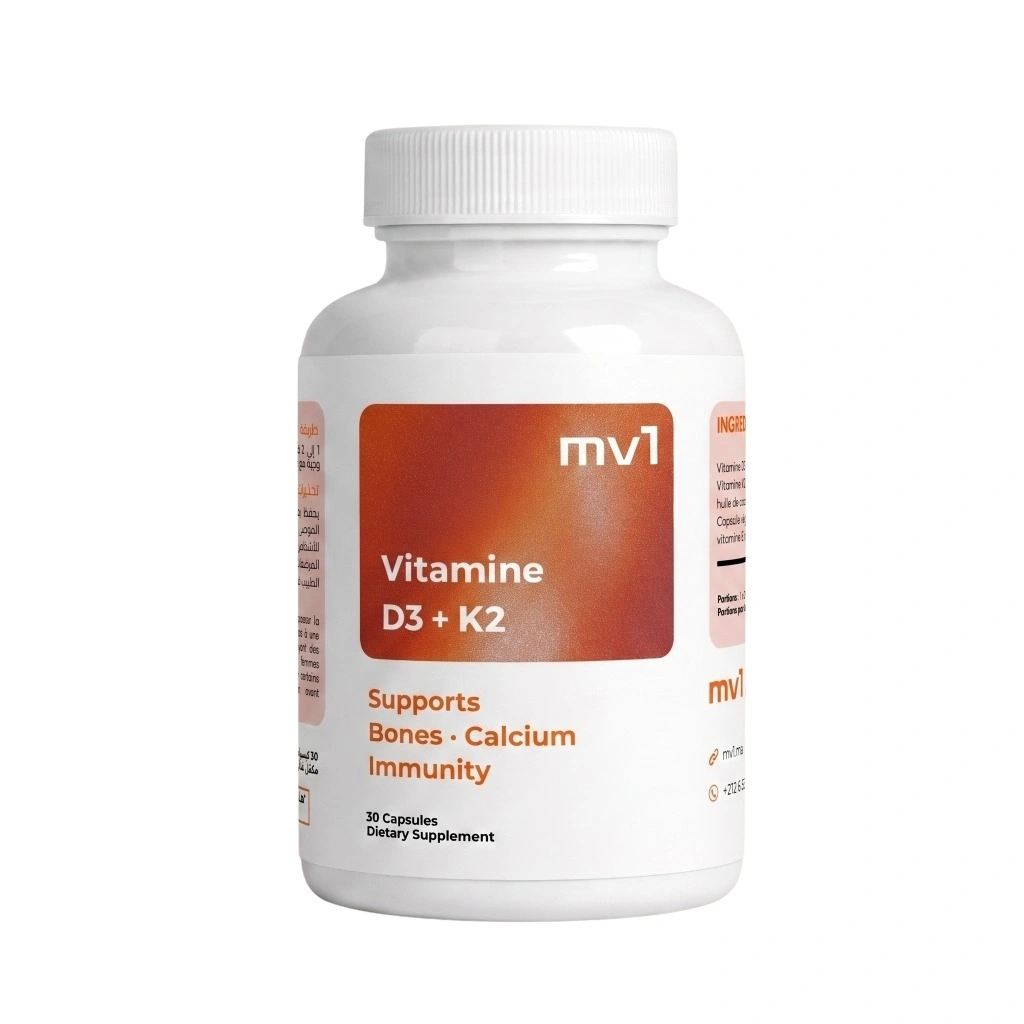
- Daily Dosage: 1 capsule of MV1 Vitamin D3 + K2 daily.
- Best Timing: In the morning with breakfast. Pair with Moroccan olive oil, eggs, avocado, or nuts to boost bioavailability by over 50%.
6. Fast Delivery Across Morocco
Protect your bones, heart, and immunity with MV1’s micro-encapsulated D3+K2 formula. Fast 24h-48h cash-on-delivery across all Moroccan regions.